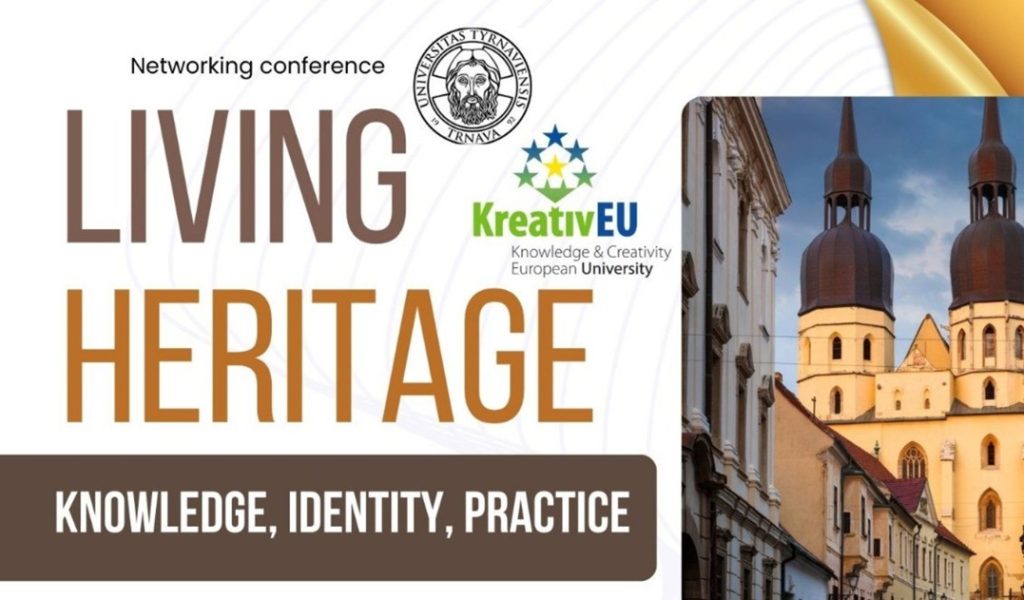
On November 27-28, the research team of the project „Understanding Roman Frontiers in Dacia: the military Fort ANGVSTIA and the functions of Limes in SE Transylvania” disseminated the newest results at the International Conference “Living Heritage: Knowledge, Identity, Practice.” This scientific event was organized by Trnava University, Breda University of Applied Science, and Polytechnic University of Tomar, in the context of the European university alliance KreativEU (Knowledge & Creativity European University), under the auspices of UNESCO UNITWIN Network Heritage Preservation, Science, Communication for Sustainable Communities. The main thematic areas of the conference included: Interdisciplinary Frontiers in Heritage Studies, Bridging Tangible and Intangible Heritage, Cultural Identity and Heritage Transmission, Cultural Heritage Management, etc.
The paper presented by Ioana-Daniela Dulama and Ioan-Alin Bucurică is entitled „Phosphorus Analysis in Archaeology: The Scientific Witness of Ancient Human Settlements” and proposes the introduction of statistical analysis elements and calculation factors that would allow for more accurate identification of areas of utility within an archaeological site. Thus, we consider that the project „Understanding Roman Frontiers in Dacia: the military Fort ANGVSTIA and the functions of Limes in SE Transylvania” brings elements of novelty and originality to the field of archaeological investigations, especially in non-invasive research prior to excavations.