
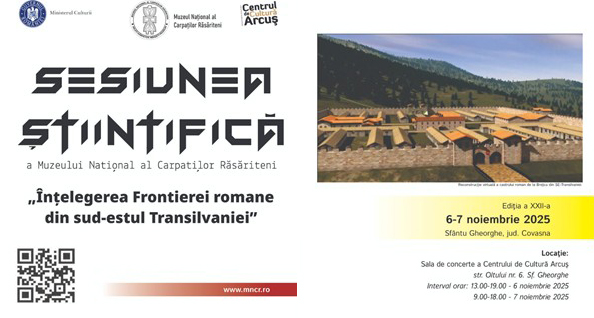
On November 6-7, members of the research team of the project „Understanding Roman Frontiers in Dacia: the military Fort ANGVSTIA and the functions of Limes in SE Transylvania” participated at the Scientific Session of the National Museum of the Eastern Carpathians “Understanding the Roman Frontiers in Southeastern Transylvania.” The scientific event brought together researchers, archaeologists, and experts in the field, providing participants with a suitable framework for presenting and discussing the latest discoveries.
Alexandru Popa presented the paper “The Castles of Boroşneu Mare, Comolău, Baraolt – The state of research at the closure of the application process for inclusion in the UNESCO World Heritage List.” and Mátyás Bajusz presented the paper “New research in the fort of Olteni and its surroundings,” thus establishing the context in which our research project takes place.
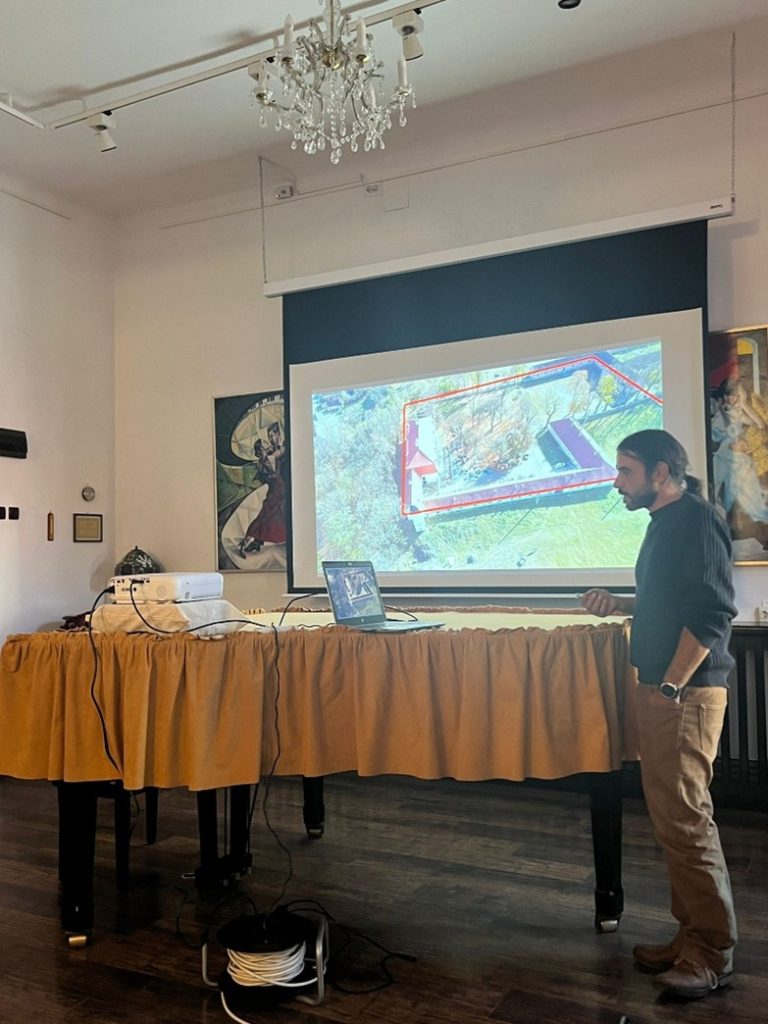
The purpose of the conference was to present and discuss the latest research findings and theories regarding the Roman frontiers in southeastern Transylvania. The research area, southeastern Transylvania, is defined as the area within the Curvature Carpathians. Geographically, it consists of the Tg. Secuiesc and Bârsa depressions, being enclosed between the Roman auxiliary forts at Brețcu, Olteni, Hoghiz, and Râșnov. Thus, from a spatial point of view, the research area represents an “identity micro-region”. Due to this specificity, the study of the Roman frontiers in southeastern Transylvania offers valuable insights into the military, political, economic, and cultural aspects of this region in relation to the province of Dacia, the Roman Empire in general, and its neighbours. This is the context in which our project fits in successfully.
The second paper presented by the project leader, Alexandru Popa, “Research Issues in the Breţcu-Oituz Area,” specifically addressed the site at Breţcu and the challenges it faces from the perspective of research and interpretation of the results obtained so far.
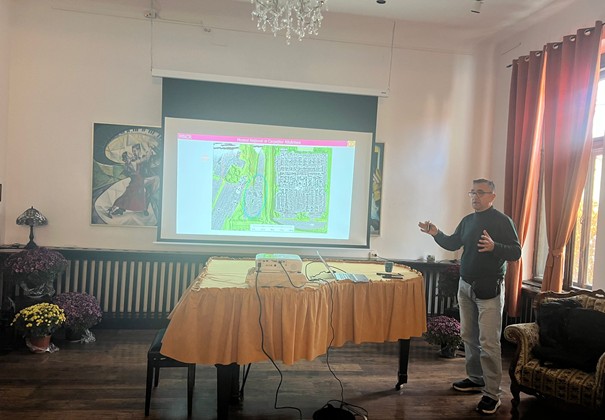
The second paper presented by the project leader, Alexandru Popa, “Research Issues in the Breţcu-Oituz Area,” specifically addressed the site at Breţcu and the challenges it faces from the perspective of research and interpretation of the results obtained so far.
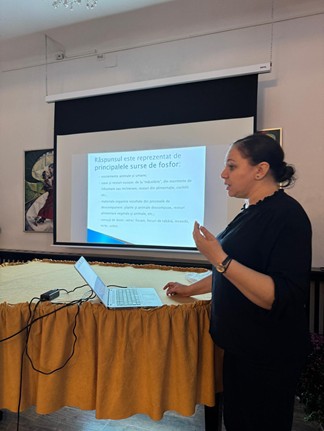
Andrea Popa presented the paper “Integrated management of the Roman Dacia Frontier sites in SE Transylvania. First impressions after inclusion in the UNESCO World Heritage List.” from the perspective of the relationship with local communities, especially with the non-academic public. One of the objectives of our project is to bring this non-academic audience closer to understanding the scientific results, which tell the real, documented, and proven story of a cultural heritage that belongs to the local community.
As always, following the Scientific Session, opportunities for individual development and potential interdisciplinary collaborations were identified. The project team will continue to disseminate the results obtained within the project both at scientific events (national and international) and by publishing them in specialized magazines/journals.